Sunday, September 18, 2011

#17 Potato Onion Rye Meteil


Overall, this recipe was enlightening but frustrating. First, for this bread, Reinhart gives a recipe that makes two loaves instead of the usual one—something I initially overlooked. My intention had been to make three half-loaves but I ended up making three full loaves, a lot more bread that I wanted or can use.

Also, along the way, I discovered source of another problem I was having. I typically use a fairly wet starter when making sourdough breads—a starter that is equal parts flour and water. This makes feeding the starter particularly easy. I should have remembered that Reinhart's recipes call for a stiffer starter (or checked), but I didn't.. (I read the introductory material in the book quite some time ago. Obviously, I need to reread it.) It is fairly easy to correct for a wet started, but this isn't something I have been doing. And since these recipes use a hefty amount of starter, I've been adding more water/less flour than the recipe called for. Hence the sticky dough. Mea culpa.

My goal in making three (half) loaves was to experiment with the kneading to see what really works best and to see if that was the cause of the problem with the last loaf. There is some inconsistencies among bakers as to the optimal kneading of rye breads. It is certainly the case that rye breads can be over kneaded. But, there is also the question whether you want to go until the dough passes the window-pane test or stop just short of that point. The rational of stopping a bit short is that the gluten will continue to develop during fermentation and proofing and with additional handling.

With this in mind, I set out to make three otherwise identical loaves but with different degrees of kneading. I began by mixing one large batch of dough, one and a half times the original recipe up to the point of kneading. I then divided the dough into three equal portions and kneaded by hand the first portion three minutes, the second portion five minutes and the last portion seven minutes. The first loaf was way short of passing the window-pane test, the second loaf just short of passing, and the third loaf clearly passed the test.

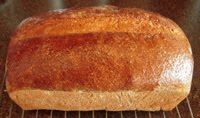
The loaves are shown left to right in the first picture and from bottom to top in the second picture. The under-kneaded loaf clearly fell short of an optimal loaf. It was the slackest loaf, had a dense crumb, and showed the crumbly crust around the scoring seen in my previous loaf. The loaf that was just short of passing the window-pane test proved to be the best loaf by a small margin. It had the most pleasant crumb and the best shape.

As an aside, where Reinhart says you can use either rye or whole wheat flour, I used an equal mixture of the two. In Reinhart's Baker's Formula, he reports that the bread is 24% rye and 76% whole wheat. In doing so, he is clearly assuming that the baker is using all whole wheat when faced with a choice. The percentages would be reversed (roughly) if the baker used all rye instead. In using an equal mixture, I made a loaf that was about 50% rye.

As for overall taste, this recipe is okay. The experiment will help me judge my loaves and improve. But this isn't a recipe I'm likely to make anything soon. And I certainly wouldn't make two full loaves, let alone three.

#16: Rye Sandwich Seigle


This was pretty much a repeat of the last loaf but with a lot more rye (60% rather than 40%). Again, I made a half loaf. I used milk and molasses and skipped the optional seeds.

The dough was uncharacteristically wet and sticky—very difficult to work with. The results were a heavy, unattractive loaf that tended to crack and produced a ragged looking texture around the scoring. I suspect this came from under-kneading the dough (in part because it was so wet and sticky). This tasted okay but was not a loaf to get excited about. This isn't a loaf I'm likely to make again.

Sunday, September 4, 2011

#15: Rye Sandwich Meteil


Because I'm not overly fond of rye breads and, as part of the Hamelman Challenge, I had just made a three and half pound plus miche the day before, I elected to make half the recipe for this bread. And, since I was making half the recipe, I mixed and kneaded the loaf entirely by hand rather than use my stand mixer. Overall, I think this improved the loaf and may make this a standard practice when making rye breads. I used molasses rather than the other choices; I used the optional minced dried onions; and I omitted the optional seeds.

This produced a very nice little boule with a pleasant flavor. It should be noted that the onions dominated the flavor of the bread, but that was fine with me. This did not have a strong rye taste.


Sunday, August 28, 2011

#14: Oat Bran Broom Bread


So here is my shot at the Oat Bran Broom Bread. I, for what it is worth, could have gone for a less descriptive name. The recipe is very much like the others that have gone before—make a soaker, make a biga, mix these with a few other ingredients the next day, and then jump to another page to see how to finish the bread.

The recipe produces a very pleasant if nondescript loaf. Reinhart suggest making it either in a loaf pan or as a free-standing loaf. There seems to be some inconsistencies with the French terminology. Reinhart calls for making a bâtard, by which he means a torpedo shaped loaf. This seems to be pretty standard usages in the US but I gather the French use boulot for a torpedo shape while a bâtard is more a log shaped loaf. (Any clarification or corrections would be appreciated.) In any event, I opted to make a log-shaped loaf.

The crust is, well, nondescript. It didn't brown very deeply, and the slashes seemed to disappeared into the crumb. This is a loaf that calls out to be brushed with butter or decorated with seeds. In the photo in the book, it appears that Reinhart covered the top of the loaf with bran. With his merging of recipes, this is a detail that seems to have been omitted from the recipe.

Overall, this is a pleasant loaf that I would repeat.


Thursday, August 25, 2011

#13: Multigrain Struan


Struan, Reinhart says, launched his baking career. A recipe for struan, in one from or another, can be found in most of Reinhart's books. It certainly seems to be one of the recipes that he is particularly proud of and justifiably so. All the various recipes are for multi-grain breads and use a variety of seeds and grains. There is actually a great deal of leeway in all of his struan recipes when it choosing these. Yet every time I have made one of his struans, it has worked, often with spectacular results. I particularly recommend the recipe in Bread Baker's Apprentice. And, on the off chance you have leftover struan that is starting to go stale, cubes of the bread fried in butter or a good olive oil make an astonishingly good crouton.

For this recipe, I used some of King Arthur's Harvest Grain Blend that I had in the freezer, a product with which I have been particularly pleased. This is an ideal loaf for sandwiches, so I went with the loaf pan, but I expect it would make great dinner rolls as well.

This is a good loaf that I would readily recommend. This particular struan turned out, for me at least, a bit heavier than the others I've made in the past. Still, I just finished a peanut butter sandwich made with this bread and am happy to report that it was quite tasty. A great bread.


#12: 100% Whole Wheat Sandwich Bread


Starting with this loaf we are leaving the transitional breads behind. Now we are in serious whole grain territory. Although not on the cover of the book, this is (or at least should be) the iconic loaf for this book. This is the first recipe in the book and one of the recipe that Reinhart refers back to in later recipes, "Proceed as in steps 3 through 7 in the whole wheat sandwich bread on page 97."

While the recipe can be made in a loaf pan, as a free standing loaf, or even as rolls, for me a "sandwich bread" calls out for a loaf pan. I slightly doctored the recipe, as can be seen in the before and after pictures to the right. The original recipe gives a crust that is flat and dull. All I've done (second picture) is brush the loaf with melted butter. The recipe doesn't call for this, but it is easy to do and dramatically (I think) improves the appearance of the loaf.

Overall, this is a quite reasonable loaf. The recipe is clearly written, and I didn't encounter any problems. The flavor was good, but I wasn't overwhelmed by it. I found the bread a bit dry and the loaf didn't keep particularly well. Overall, I prefer the first loaf in the challenge, the Transitional Whole Wheat Sandwich Bread to this recipe. But that is just my preference.

#11: Transitional Rustic Bread & Focaccia


This is a recipe I'm returning to. It can be used to make either two loaves of a rustic bread, basically a ciabatta, or one focaccia (or even several mini-baguettes). Although it has been a while, I have done all of these. This time around, as you can see, I went with the ciabatta.

I'm a big fan of both ciabatta and focaccia. In fact, a couple of years ago, I attended Peter Reinhart's Saturday morning course on making focaccia and pizza at Johnson and Wales in Charlotte, a course I recommend. Although this book was out at the time, in that course we stuck to white bread flour. Sometime after the course, I tried this recipe a couple of times.

Overall, the loaves were quite good. They don't quite deliver the light chewiness of a traditional bread-flour ciabatta, but they are still reasonably light, chewy and they do have a good flavor. (Yes, I admit that my preference runs toward white bread flours rather than whole wheat flours. Perhaps focaccia, with the distraction of toppings, is a better choice for me. )

As a transitional bread, it will be interesting to see how this compares to 100% whole wheat ciabattas. This is a recipe well worth making again. Perhaps I can find the time in the near future to redo this recipe making the focaccia. If I do, I'll update this post.