Sunday, January 22, 2012

#35 Whole Wheat Brioche


Note: Recipe #34 call for spent grains. Thus far, I have not been able to locate this ingredient. Once I have done so, I will return to that recipe. But for now, I'm moving on.

The whole wheat brioche is a repeated recipe for me, so I elected to do the optional Kugelhopf form of the recipe. Compared to most brioche recipes, this is a remarkably easy loaf to make. The almonds didn't want to adhere to the pan, so I just pressed them into to the dough. Other than that, there were no problems.

While the recipe doesn't produce the decadent loaf you might expect of a brioche, the results are quite tasty. The bite of the whole wheat is more than off-set by the added butter. So while not exactly a desert loaf, this isn't a stogy whole wheat loaf either. Overall, a good loaf. Dust with powdered sugar!

Sunday, January 8, 2012

#33 Steamed Boston Brown Bread


First, this isn't bread, this is dessert. This recipe produces a very soft, sweet bread that is more like a cake or a muffin than a traditional bread or even a fruit bread.

For the most part, the recipe is straightforward. It calls for cooking the bread in a coffee can (whatever that is). I found an old charlotte mold and used that instead. The bread cooks for three hours, so if you make this bread, plan accordingly. But it is made on the stove top.

Still, when all is said and done, it is a delicious bread and worth the effort. Reinhart mentions using other fruit, but I can't help wondering how well walnuts would work?

Sunday, January 1, 2012

#31 Whole Wheat Mash Bread and
#33 Multigrain Mash Bread


Frankly, this was another set of loaves that I had my doubts about. It should be clear that I'm not really a whole grain kind of guy. I'm doing this challenge to broaden my horizons and see what I might like and what I don't like. And occasionally, there are a few surprises along the way. But these loaves didn't look that promising to me.

Creating the mash for these breads is an involved processes so I decided to make both loaves at once. To create the mash you take flour or grains, add hot water, and then bake it in a low oven (150 degrees) for one to three hours. If your oven won't go that low, Reinhart suggests cycling the oven on and off every 10 minutes. Fortunately, my oven did go that low although I needed to use an oven thermometer and play with the settings. The dial was not particularly accurate in this range. But that a lot better than cycling the oven every 10 minutes.

For my loaves, I cooked the mashes about two hours. After that time, they turned into gelatinous gruels that looked even less promising than the original recipes sounded. I created the soakers and let both sets sit out over night. Forming and baking the loaves was straight forward and uneventful. As can be seen, I elected to use loaf pans rather than make freestanding loaves.

And the results? These were two excellent loaves, if somewhat nondescript. (I brushed both with butter and that helped their appearance somewhat.) But the flavor was excellent. Really! Typically, my tastes run to multigrain over whole wheat, but in this case I preferred the whole wheat loaf. Live and learn.

Tuesday, December 20, 2011

#30 Julekage, Panettone, and Stollen


These are three very similar recipes, varying only slightly in terms of flavoring and shaping. According to the original schedule, we were to select one of the three. But, since the recipe makes three small loaves, I decided to make one of each. My strategy was to mix the dough with out the flavorings, cardamon for the jutekage, almond extract for the stollen and orange extract for the panettone. I then added the flavoring to the mixed dough after dividing it into three portions. This strategy worked well with the stollen and panettone, but the cardamon was a bit sharp tasting in the jutekage.

Overall, the loaves worked well. With the whole grains, all three loaves were heavier than what you would normally expect for these loaves, at least for traditional recipes. Still, all three were fine. The loaves, as shown top to bottom, jutekage, stollen, and panettone.

#28 Whole Wheat Sprouted Grain Bread & #29 100% Sprouted Grain Bread


Because both of these breads use sprouted grains, I elected to make them at the same time. Since I was using wheat berries that I had purchased and frozen sometime ago, I was uncertain whether they would sprout properly. As it turned out, the grain was fine. I must admit, I was a little skeptical of the idea of a sprouted grain bread, having never had the bread before. Being unsure of how the bread would turn out was part of the motivation for making both loaves at once. For these reasons, I made a full loaf with the first recipe. For the second recipe, I made two mini loaves, the equivalent of a half a loaf.

The grain was sprouted as directed. I ground the sprouted grain using a meat grinder. The texture was a little strange but the doughs worked fine.

Frankly, the results were quite surprising. Both loaves were quite good. The texture was chewy and the flavor was fine. Perhaps more surprisingly, I preferred the 100% sprouted grain bread over the whole wheat sprouted grain bread. This is clearly a loaf worth remembering and, at some point, trying again.

Saturday, November 26, 2011

#27 Power Bread


If we don't worry about variations and choosing only one of a set (like the last choice with rye), this bread marks the halfway point in the challenge. Overall, this is a bit different from previous loaves. I wasn't quite sure what to make of a power loaf. The connotations, for me at least, are of a heavy, calorie laden bread—not something that is very appealing. The loaf is also a bit unusual in that it has a pre-soaker as well as a soaker and biga. This stretches the recipe out to three days.

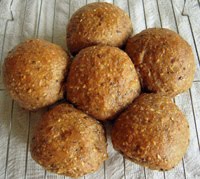
Options were for a loaf or rolls (or bars). I cut the recipe in half and made a half-dozen rolls. Since the rolls have an egg-glaze, I skipped steaming the oven with no obvious ill effects. Overall, the taste was a bit unusual but not bad. These weren't particularly heavy, I'm please to report. But I would strongly suggest toasting and eating these with butter.

#26 45% Rye Bread


The next bread in the challenge is the choice among "Three Rye Hearth Bread Variations" as Reinhart puts it. We were given the choice of a 45% rye, 68% rye, and a 100% rye. Frankly, it seems a little like cheating to only be making one of the three if our goal is to work our way through the book. Still, since I'm not overly fond of rye breads, for now I'll stick to a single loaf. Perhaps I'll come back to the other two later.

My choice was the loaf with the smallest rye content. This is closer to what I prefer and, with the reduced rye content, a much easier loaf to make. I made the recipe pretty much as given. There is an option of adding caraway, nigella, anise seeds or dried mince onions. I went with the latter and regretted it. I really didn't like the aroma of the bread. Had I to do it over, I would have omitted all the optional additions.

I chose a log-shaped loaf and played with another type of scoring that I've often seen on small rye loaves. Overall, a pleasant loaf.