Tuesday, January 1, 2013

#34 Spent-Grain Bread

 
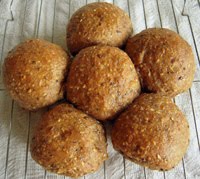
For me, this loaf was the major stumbling block in the book, the one loaf I doubted I would be able to complete when I began the project. Spent grain bread uses the "spent" or leftover grain from brewing. After the wort has been strained off the grains, the wort is used to create beer. The grains are discarded. While making bread is an ideal use for these spent grains, I was at a loss of how to come by this ingredient. Reinhart suggests exchanging bread for spent grains with a brewer, but I'm afraid I don't know any brewers. So, when I originally came to this recipe, I skipped over it. As I neared the end of the book last summer, I knew it was time to get back to this bread.

Ultimately, my solution was to create my own spent grains.I began by sprouting wheat. After a few day, I toasted the wheat and made my own wort. But unlike the traditional beer maker, I discard the wort and kept the grains. These were dried, coarsely ground, and then incorporated into the bread.

Frankly, I didn't have high expectations for the loaf.  I was doing this more from a compulsive drive to complete the book.  In fact, I found this to be one of the best breads in the book. While it was way too much work the way I did it, I would certainly make the bread again if I had a reliable source of spent grains.

#47 Chapatis, Parathas, and Roti

 
Since my last post was in May, it would appear I've abandon this project.  Actually, as to the baking, I've finished the book early last summer.  As to blogging, well it is fairly obvious that has fallen by the wayside. In fact, the interface has changed enough that I'm having to rediscover how to do the blogging.  Still, I'd like to wrap this up so I hope (but don't swear) to post a little each day until I'm done.  Still, this will translate into as best I can remember in most cases.

This posting is for three very similar Indian breads, Chapatis, Parathas, and Roti. All are nonyeasted flat breads.  The soaker is in fact the dough with Reinhart's recipe. The basic difference among these is how thick or thinly the dough is rolled and shaped.  All are cooked stove top in a skillet.

Chapatis are shown above but it is fairly easy to make all three at one go, as I did, to see which you like best. These worked well, but this is clearly a case of Reinhart reinventing classic Indian breads. I'm not sure how I feel about this since I have only a passing acquaintance with these breads. Personally, I need to go back and make each of these breads several time using traditional recipes before I can pass judgement on Reinhart's.

Tuesday, May 15, 2012

#46 Whole Wheat Naan

Naan is traditionally made with whole wheat flour so its inclusion in this book makes a lot of sense. On the other hand, naan is typically cooked in a tandoor oven at extremely high temperatures so cooking it at home can be less than optimal.

Unlike pita, the previous recipe, this is much simpler. While the dough is prepared the night before, this does not require a soaker or preferement. (You still need to refrigerate the dough overnight.) Baking is done on a stone but with out a steam pan. (I can't help but wonder if a preheated cast iron pan would have worked better. I didn't try it.) The picture shows two naan before being brushed oil or butter. I prefer the butter.

Overall a very nice recipe. But having made naan without the delayed fermentation, I can't really say this is better. Perhaps if I tried them side-by-side?

#45 Whole Wheat Pita

For so simple a bread as pita, this seems an overly complex recipe with soaker, biga, and overnight fermentation. I think of pita as a relatively quick bread. Still, it seemed worth trying.

The recipe is not difficult if a bit tedious. The recipe worked as expected. The picture shows three breads. The first was overcooked and hardened in its puffed state. The second shows the browned side that rested on the stone. The third shows the puffed side.

Overall, the bread was fine. I have no real complaints. But then again, I wasn't overwhelmed by it either. This is probably a recipe that would work better as a transitional bread than as a 100% whole wheat bread.

#44 Multigrain Pizza

This was another combination recipe—either whole wheat or multigrain pizza. Having previously made Reinhart's whole wheat pizza, I elected to make a multigrain pizza this time around. (In the interest of full disclosure of biases, I typically prefer multigrain breads to whole wheat breads.)

I followed the recipe as written. For my grains, I used the Harvest Grain mix from King Arthur, a longtime favorite of mine. I used a variety of toppings, including leftover taco filling, salsa, and cheddar cheese; two pizzas with pesto, feta and nuts, one with pine nuts and one with walnuts; and two with tomato sauce and cheese, one with onions, mushrooms, and pepperoni, and another with sausage and walnuts. All were excellent. This isn't your usual pizza but the crust worked well, particularly with toppings combinations that include walnuts. Another pleasant recipe worth making again.

#43 Whole Wheat Focaccia

I love focaccia but when I think of focaccia, I think of a light, open bread. The idea of a whole wheat focaccia is a bit contradictory for me. Still I thought it worth a try. And indeed it was.

I made half the recipe following the recipe closely.  I topped the focaccia with Gorgonzola, walnuts, and caramelized onions. The results weren't as light as a traditional focaccia, but were nonetheless quite tasty.

Overall, this is an approach that works beautifully for whole wheat giving an unexpectedly light product. (Also, if you are trying to work your way into whole grains, along with the transitional breads, this is a good place to start.) The recipe gives an option of making Pain À L'Ancienne Mini Baguettes which I did not attempt. This is certainly work going back and doing in the future. This recipe is a keeper.

#42 Multigrain & Pumpernickel Bagels

Once again, I've had a very long break in writing. In the meantime, I've taken on a couple of new challenges. As the Hamelman challenge has drawn to a close, the Mellow Bakers have started up a new challenge to bake through The Handmade Loaf by Dan Lepard. I haven't created a blog for this yet, but I've made ten recipes from this book, the first four recipes in the challenge along with six others.

I've also created a personal challenge, to bake through Baking Artisan Bread by Ciril Hitz over a period of ten weeks. This book is organized around ten basic formula with variations for each. I'm eight weeks into this challenge and am on schedule. Again, I haven't created a blog for this either. As to this challenge, I'm five posting behind. So, over the past couple of months and done lots of baking but very little writing. So it's time to catch up.

Having previously made Reinhart's whole wheat bagels, for the next recipe I opted to make multigrain and pumpernickel bagels. Using the biga recipe as given, I made half a recipe each of the soakers for the multigrain and pumpernickel bagels. I divided the biga the next day and made two sets of bagels otherwise following the recipe as given. In each case I used the barley malt syrup. With the pumpernickel bagels, I opted for the molasses over sorghum. My memory is a bit hazy at this point. For the grains, I believe I used a Quaker Oats Multigrain cereal. In the photo, these are the ones with the black and white sesame seeds.

Frankly, the results were less than stellar—okay but not exciting. Since bagels tend to be dense and chewy to begin with, the use of whole grains can lead to a very heavy product. This was not my favorite.

Sunday, March 4, 2012

#41 Hapanleipä


Having already done the Christmas breads, Hapanleipä and Vorterkaker are the last two international breads. These are very similar breads, one Finnish and one Norwegian. The challenge calls for making one or the other because of their similarity. Since the Norwegian bread is flavored with anise, I went with the other.

As a rye, I went with hand mixing and kneading. Overall, the recipe was fairly straightforward and I didn't encounter any problems. The loaves are thin and almost cracker like. Actually, I wished I'd baked them a little longer and gotten a crisper result. Still a very pleasant loaf to be eaten like a cracker.

Next week it is on to bagels and flatbread. I'm looking forward to these!

#40 Santa Lucia Buns


As we near the end of the sections on International Breads, we find Swedish Santa Lucia Buns commemorating the Sicilian saint who, Reinhart tells us, was blinded rather than renounce her faith. These are whole wheat rather than rye and so much more to my liking. As can be seen, than can be made with or without the raisins that symbolize the girls eyes.

Overall, these were straightforward to make and very pleasant. They make pleasant dinner rolls, but have, like many dinner rolls, a short shell life.

A pleasant bread worth making again.

Aside: Reinhart Video on Epoxy Method


If you haven't seen it, there is a nice TED video by Reinhart in which he explains the epoxy method, the method he uses to create the loaves used in Peter Reinhart's Whole Grain Breads. It can be found at:
http://www.ted.com/talks/peter_reinhart_on_bread.html

#39 Swedish Limpa Rye


After the last two fiascos with rye bread, I decided it was time to change my strategy and shift to making ryes by hand rather than using my Kitchenaid mixer. This, I reasoned, would give me greater control and a better feel for the dough. And, as the next bread was another rye, it was time to make the switch.

And I have to admit, the strategy seems to have paid off. While not a perfect loaf, this was a considerable improvement over the last few loaves. This was a much lighter and well behaved loaf with a nice crumb. It wasn't quite as light as I would have liked, but was definitely not the sort of heavy loaf I have come to expect. It also had a wonderful aroma from the orange flavorings. Unfortunately, the anise gave the loaf a disappointing taste. Still, I'm going in the right direction.

Bottom line, if you like anise, you'll probably like this bread.

Saturday, March 3, 2012

#37 Bavarian Pumpernickel and #38 Hutzelbrot with Dried Fruit


Because both of these breads require a mash, I chose to make them at the same time. For both, I went with the powdered malt and the optional altus. Other than that, I pretty much followed the recipes.

Considering my track record with ryes, it shouldn't be too surprising that both of these produced heavy, dense, unpleasant loaves. And, frankly (as you can see from the pictures,) two butt-ugly loaves.

Clearly, my technique with ryes needs works. These were two forgettable loaves I don't plan to make again.

#36 Vollkornbrot


It has been about five weeks since I've posted anything. I've still been baking, but I just haven't made it back to the blog. Unfortunately, that means I'm writing from rapidly fading memories. So I'll keep these next few entries short.

This is a heavy, dense bread. You often hear the expression "sandwich rye." Then, by extension, this must be a cracker rye. This certainly isn't a bread I'd use to make sandwiches, but it is quite appropriate to eat with cheese or deli meats, very much the way you would use a cracker. In generally, these heavy 100% ryes don't work well for me, but this one came out quite well. This was something of a surprise.

I've made Hamelman's version of this. I preferred this one, but, considering my track record with ryes, I may not be being fair to Hamelman.

Overall, a pleasant loaf (and a pleasant surprise.)

Sunday, January 22, 2012

#35 Whole Wheat Brioche


Note: Recipe #34 call for spent grains. Thus far, I have not been able to locate this ingredient. Once I have done so, I will return to that recipe. But for now, I'm moving on.

The whole wheat brioche is a repeated recipe for me, so I elected to do the optional Kugelhopf form of the recipe. Compared to most brioche recipes, this is a remarkably easy loaf to make. The almonds didn't want to adhere to the pan, so I just pressed them into to the dough. Other than that, there were no problems.

While the recipe doesn't produce the decadent loaf you might expect of a brioche, the results are quite tasty. The bite of the whole wheat is more than off-set by the added butter. So while not exactly a desert loaf, this isn't a stogy whole wheat loaf either. Overall, a good loaf. Dust with powdered sugar!

Sunday, January 8, 2012

#33 Steamed Boston Brown Bread


First, this isn't bread, this is dessert. This recipe produces a very soft, sweet bread that is more like a cake or a muffin than a traditional bread or even a fruit bread.

For the most part, the recipe is straightforward. It calls for cooking the bread in a coffee can (whatever that is). I found an old charlotte mold and used that instead. The bread cooks for three hours, so if you make this bread, plan accordingly. But it is made on the stove top.

Still, when all is said and done, it is a delicious bread and worth the effort. Reinhart mentions using other fruit, but I can't help wondering how well walnuts would work?

Sunday, January 1, 2012

#31 Whole Wheat Mash Bread and
#33 Multigrain Mash Bread


Frankly, this was another set of loaves that I had my doubts about. It should be clear that I'm not really a whole grain kind of guy. I'm doing this challenge to broaden my horizons and see what I might like and what I don't like. And occasionally, there are a few surprises along the way. But these loaves didn't look that promising to me.

Creating the mash for these breads is an involved processes so I decided to make both loaves at once. To create the mash you take flour or grains, add hot water, and then bake it in a low oven (150 degrees) for one to three hours. If your oven won't go that low, Reinhart suggests cycling the oven on and off every 10 minutes. Fortunately, my oven did go that low although I needed to use an oven thermometer and play with the settings. The dial was not particularly accurate in this range. But that a lot better than cycling the oven every 10 minutes.

For my loaves, I cooked the mashes about two hours. After that time, they turned into gelatinous gruels that looked even less promising than the original recipes sounded. I created the soakers and let both sets sit out over night. Forming and baking the loaves was straight forward and uneventful. As can be seen, I elected to use loaf pans rather than make freestanding loaves.

And the results? These were two excellent loaves, if somewhat nondescript. (I brushed both with butter and that helped their appearance somewhat.) But the flavor was excellent. Really! Typically, my tastes run to multigrain over whole wheat, but in this case I preferred the whole wheat loaf. Live and learn.

Tuesday, December 20, 2011

#30 Julekage, Panettone, and Stollen


These are three very similar recipes, varying only slightly in terms of flavoring and shaping. According to the original schedule, we were to select one of the three. But, since the recipe makes three small loaves, I decided to make one of each. My strategy was to mix the dough with out the flavorings, cardamon for the jutekage, almond extract for the stollen and orange extract for the panettone. I then added the flavoring to the mixed dough after dividing it into three portions. This strategy worked well with the stollen and panettone, but the cardamon was a bit sharp tasting in the jutekage.

Overall, the loaves worked well. With the whole grains, all three loaves were heavier than what you would normally expect for these loaves, at least for traditional recipes. Still, all three were fine. The loaves, as shown top to bottom, jutekage, stollen, and panettone.

#28 Whole Wheat Sprouted Grain Bread & #29 100% Sprouted Grain Bread


Because both of these breads use sprouted grains, I elected to make them at the same time. Since I was using wheat berries that I had purchased and frozen sometime ago, I was uncertain whether they would sprout properly. As it turned out, the grain was fine. I must admit, I was a little skeptical of the idea of a sprouted grain bread, having never had the bread before. Being unsure of how the bread would turn out was part of the motivation for making both loaves at once. For these reasons, I made a full loaf with the first recipe. For the second recipe, I made two mini loaves, the equivalent of a half a loaf.

The grain was sprouted as directed. I ground the sprouted grain using a meat grinder. The texture was a little strange but the doughs worked fine.

Frankly, the results were quite surprising. Both loaves were quite good. The texture was chewy and the flavor was fine. Perhaps more surprisingly, I preferred the 100% sprouted grain bread over the whole wheat sprouted grain bread. This is clearly a loaf worth remembering and, at some point, trying again.

Saturday, November 26, 2011

#27 Power Bread


If we don't worry about variations and choosing only one of a set (like the last choice with rye), this bread marks the halfway point in the challenge. Overall, this is a bit different from previous loaves. I wasn't quite sure what to make of a power loaf. The connotations, for me at least, are of a heavy, calorie laden bread—not something that is very appealing. The loaf is also a bit unusual in that it has a pre-soaker as well as a soaker and biga. This stretches the recipe out to three days.

Options were for a loaf or rolls (or bars). I cut the recipe in half and made a half-dozen rolls. Since the rolls have an egg-glaze, I skipped steaming the oven with no obvious ill effects. Overall, the taste was a bit unusual but not bad. These weren't particularly heavy, I'm please to report. But I would strongly suggest toasting and eating these with butter.

#26 45% Rye Bread


The next bread in the challenge is the choice among "Three Rye Hearth Bread Variations" as Reinhart puts it. We were given the choice of a 45% rye, 68% rye, and a 100% rye. Frankly, it seems a little like cheating to only be making one of the three if our goal is to work our way through the book. Still, since I'm not overly fond of rye breads, for now I'll stick to a single loaf. Perhaps I'll come back to the other two later.

My choice was the loaf with the smallest rye content. This is closer to what I prefer and, with the reduced rye content, a much easier loaf to make. I made the recipe pretty much as given. There is an option of adding caraway, nigella, anise seeds or dried mince onions. I went with the latter and regretted it. I really didn't like the aroma of the bread. Had I to do it over, I would have omitted all the optional additions.

I chose a log-shaped loaf and played with another type of scoring that I've often seen on small rye loaves. Overall, a pleasant loaf.